
Axial Drum Cutters
Where and How Are Vertical Drum Cutters Used?
How the axial drum performs on wide surfaces, explained through job preparation, method and output, from mining to foundation work.
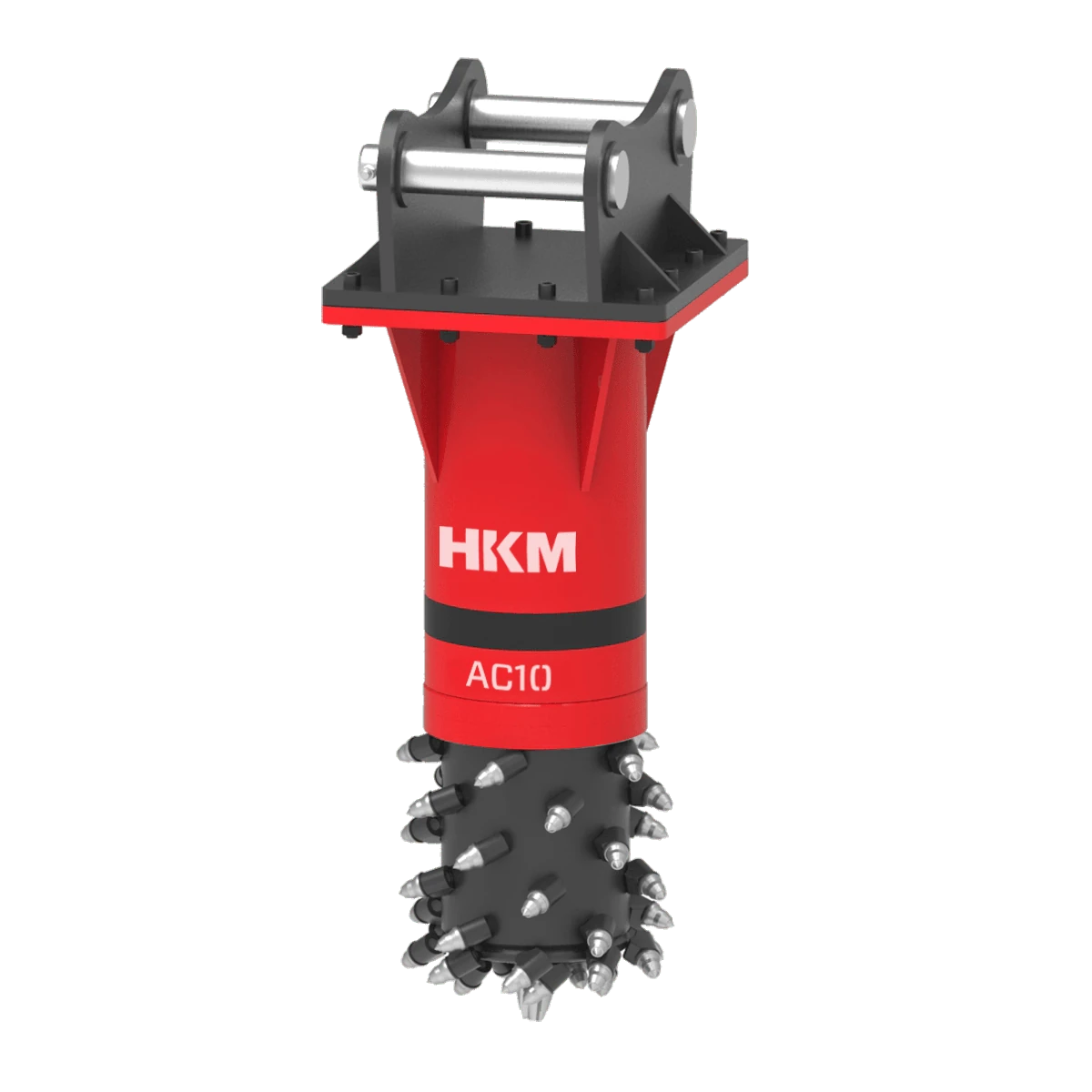
Vertical drum cutters are axial type milling attachments whose drum turns on the same axis as the excavator stick. The single wide drum at the end of the body mills rock, concrete and hard ground from the surface, layer by layer, with its cutting picks, excavating with low vibration and without blasting or impact. Because the broad face of the drum makes full contact with the material, it delivers a high material throughput on work carried out parallel to the surface, such as slope trimming, leveling wide areas, trench edges and invert finishing; the output is fine and uniform, so on most sites it goes straight into fill.
This geometry is what separates the vertical type from the transverse drum cutter. In the transverse type the drums turn on a shaft perpendicular to the stick and enter the ground along a narrow line, which makes that type the tool for trenching and cutting linear profiles. In the vertical (axial) type the contact is a surface rather than a line: the drum is laid flat against the ground and a wide strip is worked on every pass. If the job is to trim a large area, the axial type removes more material in the same time; if the job is to open a narrow, deep line, the transverse type takes over.
On site the vertical drum cutter is fed from the carrier's hydraulic circuit, and output depends on matching the attachment correctly to the carrier class. The operator presses the drum onto the surface under control, sweeps it in overlapping strips with the movement of the stick and takes a thin layer on every pass. The scenarios below describe how this way of working is actually applied in mining, earthmoving and infrastructure, tunneling and foundation work.
Mining & Quarrying
Bringing quarry slopes and bench faces to design geometry
Inside the quarry the job usually starts with bringing a slope or bench face that has already been excavated to the design geometry. During preparation, loose blocks are cleared off the surface, the target angle and line are marked out on site, and the safe working strip where the carrier will stand is defined. Fitted to a heavy class excavator, the vertical drum cutter starts work from the top level of the slope.
The operator lays the wide face of the drum flat against the slope and sweeps downwards in overlapping strips; each pass takes a thin layer and the target angle is approached in stages. Surfaces left irregular after blasting are trimmed this way without blasting and with low vibration, so the surrounding slope is disturbed far less than with an impact method. The output is a surface at the design angle, ready for drainage and protection layers; the fine milled material can be used as fill on the haul roads inside the quarry.
This attachment is not a primary production tool in the quarry: for high volume excavation in massive, very hard rock, breakers or drilling methods are the right call, and for reducing large blocks a hydraulic breaker is. The vertical drum cutter comes in after production, at the point where surface quality is what matters.
- Work starts at the top level of the slope and moves down in overlapping strips.
- A thin layer is taken on every pass; the target angle is approached in stages.
- Loose blocks are cleared from the surface before milling begins.
- The fine milled material is used as fill inside the quarry.
A common mistake on site
When too little overlap is left between strips, ridges remain between the passes and the surface has to be worked a second time. Planning each strip to run over the previous pass is the shortest route to a clean surface in one go.
Earth-Moving & Infrastructure
Precise finishing at trench edges and along utility routes
In infrastructure work the bulk excavation is usually done with a bucket, a breaker or a transverse drum cutter, and the vertical drum cutter comes in afterwards. Bringing trench walls to vertical, preparing the invert level for the pipe bed and trimming surfaces along the route are jobs for the axial drum. Preparation involves confirming the position of existing utility lines and drawing up a plan that keeps the carrier at a safe distance from the trench edge.
The operator lays the drum flat against the trench wall or the invert and works the surface strip by strip by drawing the stick along the line. When leveling the invert, the drum takes the surface down to the level line in thin layers, so the pipe bed is handed over as an even surface with hand trimming reduced to a minimum. In built up areas and near existing services, working with low vibration reduces disturbance to the surrounding pavements and structures.
In soft ground this attachment is unnecessary; a bucket is enough. Opening a narrow, deep trench in rock for the first time is not where the axial type is strong either: that geometry belongs to the transverse drum cutter or the breaker. The vertical type stands out in the trimming steps that decide the quality of the line after excavation.
- Bulk excavation is completed first; the cutter comes in at the trimming step.
- The drum is laid flat against the wall or the invert and drawn along the line.
- The invert level is reached in thin layers and the bed surface is prepared.
- Near existing services, milling is preferred over impact.
The critical distinction
Near existing pipe and cable runs, impact equipment shakes the ground carrying the line and creates a risk of damage. Once the line position is confirmed, taking the final layers with a low vibration cutter reduces that risk substantially.
Tunneling & Underground
Preparing tunnel walls and invert level for the lining
Once the main excavation has advanced in a tunnel, the walls and invert never sit exactly on the design profile, and the surfaces have to be trimmed before the lining. At this stage the vertical drum cutter maneuvers in the narrow cross section with its compact body, brings the wall faces to profile and levels the invert. Preparation involves taking profile measurements and marking the areas that stand proud or fall short; milling does not start until the ventilation and dust suppression arrangements are in place.
The operator lays the drum flat against the wall face and takes the marked overbreak off in thin layers; clearing loose material (scaling) is done with the same attachment. In a confined environment low vibration protects the surrounding rock and the support system, which makes this method safer than trimming by impact. The output is a cross section that matches the design and is ready for shotcrete or lining.
In very hard, massive rock the main excavation at the face is not this attachment's job; that calls for drilling methods or a heavy class breaker. The vertical drum cutter creates value in the fine work that follows the advance and that determines cross section quality and lining economy.
- Profile measurements are taken; areas standing proud and falling short are marked.
- Wall overbreak is milled back to the profile in thin layers.
- Loose material is cleared with the same attachment (scaling).
- The invert is leveled to the target grade before the lining.
- Dust suppression and ventilation are kept running throughout milling.
A direct effect on lining cost
Every bit of excavation beyond the profile increases the volume of lining concrete. Taking thin layers with the cutter instead of breaking the overbreak off with a hammer makes it possible to trim without going past the profile, and keeps lining cost under control.
Foundation Works
Bringing the foundation base and perimeter walls to level
After the foundation pit has been opened by bulk excavation, the base is usually left as a broken, uneven rock surface. Before the blinding and the foundation concrete, this surface has to be brought to the design level. Working from a carrier standing at the pit edge or down in the base, the vertical drum cutter mills the base in wide strips; old foundation remains and hard high spots on the surface are taken off the same way.
On the perimeter walls the attachment works parallel to the wall face and brings the excavation boundary to vertical; on plots adjoining neighboring buildings, low vibration is decisive in keeping existing foundations undisturbed. The output is an even surface ready for concrete, with its bearing capacity intact; the fine milled material is easily cleared from the pit or used as fill on site.
Deep excavation itself and breaking up large rock masses are not this attachment's field; those steps are carried out with a bucket, ripper or breaker. The vertical drum cutter is chosen for the last layer of the excavation and for the finishing step where surface quality passes straight into the concrete.
- Bulk excavation is stopped just above the target level.
- The last layer is taken with the cutter; the base is leveled to design grade.
- Perimeter walls are brought to vertical with passes parallel to the face.
- Old foundation remains are taken off the surface layer by layer.
What final leveling with a breaker costs
Leveling the base with a breaker creates micro cracks in the remaining rock and disturbs the surface the concrete will sit on. Taking the last layer with the cutter keeps the level accurate and preserves the integrity of the bearing surface.
Frequently Asked Questions
Where is a vertical drum cutter not the right choice?
High volume primary excavation in massive, very hard rock, reducing large blocks and opening narrow, deep trenches in rock are not the jobs where this attachment is efficient. A hydraulic breaker, ripper or transverse drum cutter is preferred for those steps; the vertical type comes in for surface and level trimming after excavation.
How is a vertical drum cutter used for slope trimming?
The wide face of the drum is laid flat against the slope and work moves down from the top level in overlapping strips. A thin layer is taken on every pass, so the target angle is reached gradually, under control and without blasting.
How do you work with a vertical drum cutter inside a tunnel?
After the main excavation the profile is measured and the areas standing proud or falling short are marked; the drum is laid flat against the wall face and the overbreak is taken off in thin layers. Because low vibration protects the surrounding rock and the support, this method is safer underground than trimming by impact.
What is done on site with the material produced by milling?
The axial drum cuts material to a fine and relatively uniform size. On most sites that output can be used as fill or sub-base without further crushing, which lowers haulage and disposal costs.
Get access to the HKM Dealer Portal
Access pricing, stock availability, spare parts, and technical resources. Apply now to benefit from HKM privileges designed to strengthen your business and operations.