
Crusher Buckets
Where and How Is a Crusher Bucket Used?
The job preparation, working routine and honest limits of the excavator mounted crusher bucket across four main applications, told in site language.
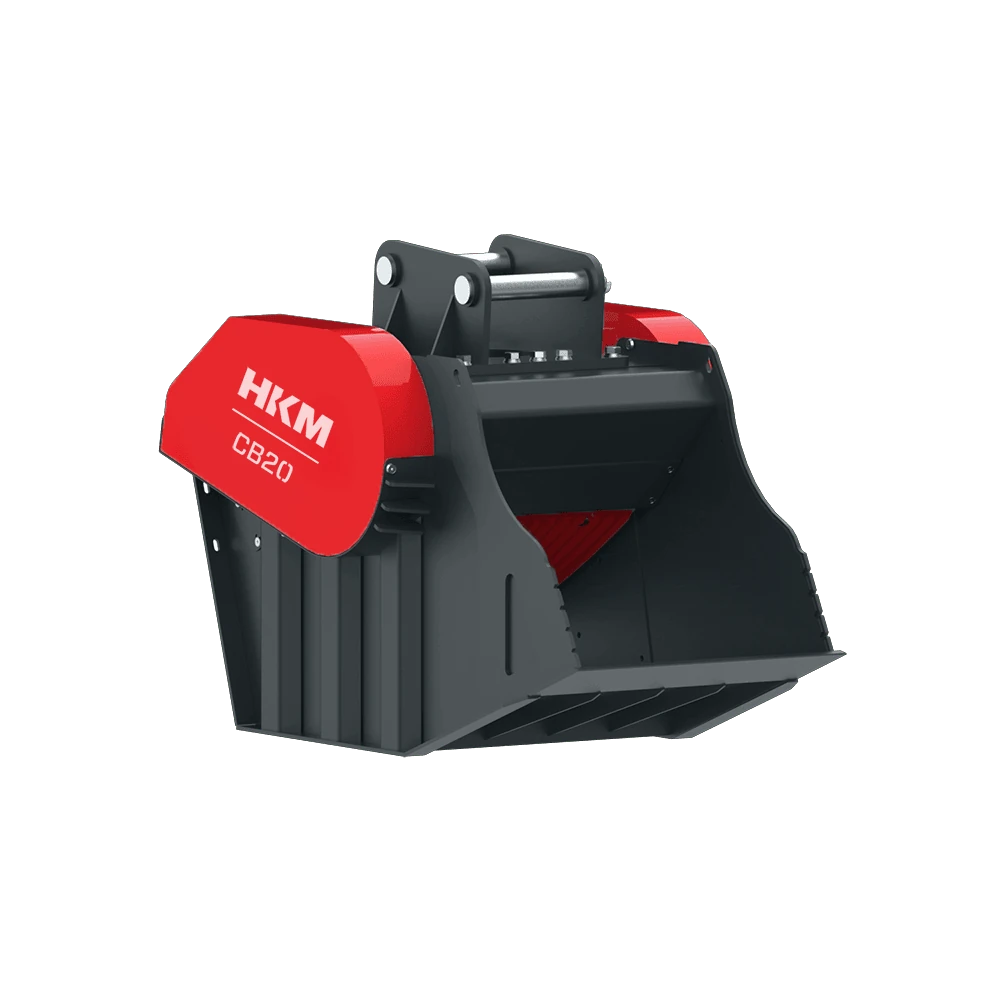
A crusher bucket is an attachment fitted to the end of the excavator stick that works on the jaw crusher principle. It grinds excavated or demolished concrete, rock and debris on site and brings it down to fill or aggregate size. The material is crushed with a single carrier and a single operator, without being hauled to a separate crusher plant; haulage and tipping costs fall, and the material can be reused on the same site.
The working principle is the same as the jaw crusher in a plant: material entering between the fixed and the moving jaw is crushed under compression, and pieces that reach the target size drop out below. Because the crushing force comes from the carrier's hydraulic system, the class and hydraulic match between attachment and excavator is settled at the installation stage. Two important limits are worth knowing from the outset: blocks that will not fit the feed opening have to be reduced first, and damp, sticky material coats the jaws and cuts output.
On this page you will find how a crusher bucket is actually run in four main applications: the job preparation, how it works with the carrier, the method step by step and where the output goes. In every section we cover the cases where the attachment is not suitable as well as those where it is strong; realistic expectations are the first condition of productivity on site.
Recycling
Processing construction waste into aggregate on site
On a recycling site the work starts with pre-sorting the debris pile. Timber, plastic, insulation material and large pieces of scrap are pulled out of the pile with a grapple or by hand; these do not crush between the jaws, they jam and stop the flow. Large reinforced concrete pieces that will not fit the feed opening are reduced beforehand with a concrete cutter or a pulverizer. A clean pile of the right size is the precondition for the crusher bucket running without interruption.
The operator fills the bucket by driving it into the pile, tilts it back slightly so the material flows into the jaw opening under its own weight, and starts the jaws; while the material is being ground inside the bucket, the carrier positions itself for the next scoop. The crushed aggregate is either tipped straight onto the stockpile or loaded into a truck. Output size is set according to where the material will be used: coarser for sub-base, finer for fill and for the layer beneath site slabs. In concrete containing tie wire, a magnetic separator unit lifts the metal residue out of the output and raises aggregate quality.
A crusher bucket is not the answer to every recycling job. Damp, clayey or sticky material coats the jaws and the inside of the bucket and drops output quickly; piles like that need to drain or be blended with dry material. Nor does a crusher bucket replace the main crusher in a fixed plant running continuous, high volume production; its strength is in work that collects material from scattered sites, where mobility comes first.
- Clear timber, plastic and large scrap out of the pile before feeding it.
- Reduce pieces that will not fit the feed opening with a concrete cutter or pulverizer.
- Set the output size according to the layer the material will be used in.
- In reinforced concrete, use a magnetic separator unit to get clean aggregate.
- Where dust is an issue, work with dust suppression equipment fitted.
A common mistake on site: feeding wet debris without letting it drain
After rain the pile coats the jaws and the bucket runs empty. Waiting for the material to drain, or blending it with dry debris, gains more by the end of the day than it costs.
Demolition & Renovation
Sequencing crushing and recovery on one machine on the demolition site
In demolition the crusher bucket comes in after the primary demolition. Once a hydraulic breaker or a concrete cutter has brought the structure down, the debris is processed where it lies with the same carrier instead of being hauled to another site. Where a quick coupler is fitted, the operator changes from breaker to crusher bucket without leaving the cab; demolition, grinding and loading are sequenced on a single machine. On tight urban plots this flow reduces both the number of machines on site and the truck traffic.
In reinforced concrete the division of labor is clear: the pulverizer grinds large reinforced pieces and strips the rebar out of them, and the crusher bucket brings the concrete, now free of steel, down to the target size. Feeding large pieces with their rebar still in place straight into the bucket can lock the jaws; long bars wrap around inside the jaws and stop the flow. That is why the debris goes through the pulverizer step before it reaches the bucket, and a magnetic separator unit does the final cleaning on any remaining wire.
The ground material is used on the same plot as ground fill, as the base of a site road or as blinding beneath the new structure; the number of truck loads going to tip falls noticeably. A crusher bucket is not a demolition attachment, though: taking down a standing structure and breaking walls or columns is the job of the breaker, the cutter and the pulverizer. In work that calls for selective removal, such as restoration, the crusher bucket only comes in once the removal is finished, to process the debris that comes out.
- Complete the primary demolition with the breaker; keep the bucket for the debris processing stage.
- Strip reinforced pieces with the pulverizer first, then feed them to the bucket.
- Change attachments from the cab with a quick coupler to keep the flow unbroken.
- Plan in advance where the ground material will go as fill and site road on the plot.
The critical distinction: pulverizer or crusher bucket?
The pulverizer is a secondary demolition attachment that separates rebar from concrete; the crusher bucket is a mobile crushing solution that sizes clean concrete. They are not rivals but two links that work one after the other.
Mining & Quarrying
Supporting the production flow with crushing at the point of work
In a quarry the crusher bucket works at the face where material has already been reduced by blasting or a hydraulic breaker, or in the stockpile area. Large blocks that will not fit the feed opening go through secondary breaking with a hydraulic breaker first; the bucket picks correctly sized material out of the pile, grinds it and delivers the output to the stockpile or straight into a truck. At production points far from the main crusher plant, this arrangement lets material be used where it lies rather than hauled long distances.
The jobs where a crusher bucket is most productive in a quarry operation are well defined: trial production, remote or temporary production points the main plant does not serve, aggregate needed for haul roads and platforms inside the pit, and interim production that keeps the flow alive during plant shutdowns. Fitted to a heavy class carrier, the bucket works in short loading and tipping cycles at the edge of the pile; the operator manages loading, grinding and tipping from one position and collects the output in separate piles according to where it will be used.
The limits should be stated openly: a crusher bucket is not an alternative to a fixed crushing line running continuous, high volume production; its strength lies in mobile and flexible work. In very abrasive, hard rock the jaw plates wear faster; the plates being replaceable makes maintenance easier, but wear monitoring has to be built into the production plan. Damp, clayey overburden is a matter of spreading and hauling rather than crushing, and is not fed to the bucket.
- Reduce large blocks to feed size with a hydraulic breaker first.
- Position the bucket at the edge of the stockpile so the cycle stays short.
- Separate the output by end use: target different sizes for haul roads, platforms and fill.
- In abrasive rock, add jaw plate wear monitoring to the production plan.
Alongside the plant, not instead of it
A crusher bucket pays back most when it is planned not as an alternative to the main plant, but as a flexible complement that keeps the flow going at remote points, on temporary work and during plant shutdowns.
Earth-Moving & Infrastructure
Producing backfill along the line during trench excavation
In pipeline and utility excavation the crusher bucket works to a routine that follows the line as it advances. Rock coming out of the trench, broken out concrete pavement and coarse fill are stockpiled along the route; at intervals the carrier fits the bucket, grinds these piles and brings the material down to a size usable as backfill. That reduces both the surplus excavation hauled to tip and the fill material brought in from outside; on narrow routes with limited truck access the difference is marked.
The method is built around the layered structure of the line. The bedding material that comes immediately around the pipe has to be fine and screened; crusher bucket output suits the backfill and sub-base layers above rather than that layer. The operator first grinds along the line, then changes to a standard bucket for placing; a quick coupler makes these attachment changes practical along the route. Broken out asphalt and concrete pavement is crushed in the same flow and used for site roads and reinstatement fill.
Not every route suits this flow. Material coming out of soft, clayey or waterlogged ground needs no crushing and coats the bucket; the crusher bucket is not brought in on those soils. Where the water table is high, the material should be left to drain. If the specification does not allow recycled material in backfill, the output is directed to work such as site roads and temporary platforms.
- Plan the crushing points in advance according to how the line advances.
- Use screened fine material for the pipe bed; keep bucket output for backfill and sub-base.
- Feed material from wet sections only after it has drained.
- Collect broken out pavement concrete in a separate pile and grind it in one go.
Do not confuse pipe bedding with backfill
A common mistake on site is spreading bucket output directly around the pipe. The bedding layer calls for fine, screened material; crusher bucket output belongs in the layers above.
Frequently Asked Questions
How is the size of the material fed to a crusher bucket prepared?
Blocks that will not fit the feed opening are never forced in; they are reduced first with a hydraulic breaker, concrete cutter or pulverizer. A pile that has been pre-sorted and sized correctly gives an uninterrupted flow without straining the jaw system.
Can a crusher bucket be used on damp or sticky material?
Only to a limited extent. Clay, mud and waterlogged material coat the jaws and the inside of the bucket and cut output. Material like this is left to drain or blended with dry material; on fully sticky ground the bucket is not brought in at all.
Is a crusher bucket enough on its own in reinforced concrete?
No. Large reinforced pieces are ground with the pulverizer first and the rebar is stripped out; the crusher bucket then sizes the concrete once it is free of steel. A magnetic separator unit deals with any remaining wire. Pieces that still hold their rebar can lock the jaws.
Where is a crusher bucket not the right choice?
Demolishing a standing structure, selective removal, continuous high volume production in a fixed plant and work in sticky ground are not the crusher bucket's field. In those jobs the work is divided with a hydraulic breaker, pulverizer, grapple or a fixed crushing line.
Get access to the HKM Dealer Portal
Access pricing, stock availability, spare parts, and technical resources. Apply now to benefit from HKM privileges designed to strengthen your business and operations.