
Grapples
Where and How Are Grapples Used?
How work is actually carried out on site with sorting and log grapples, step by step, from job preparation through method to output.
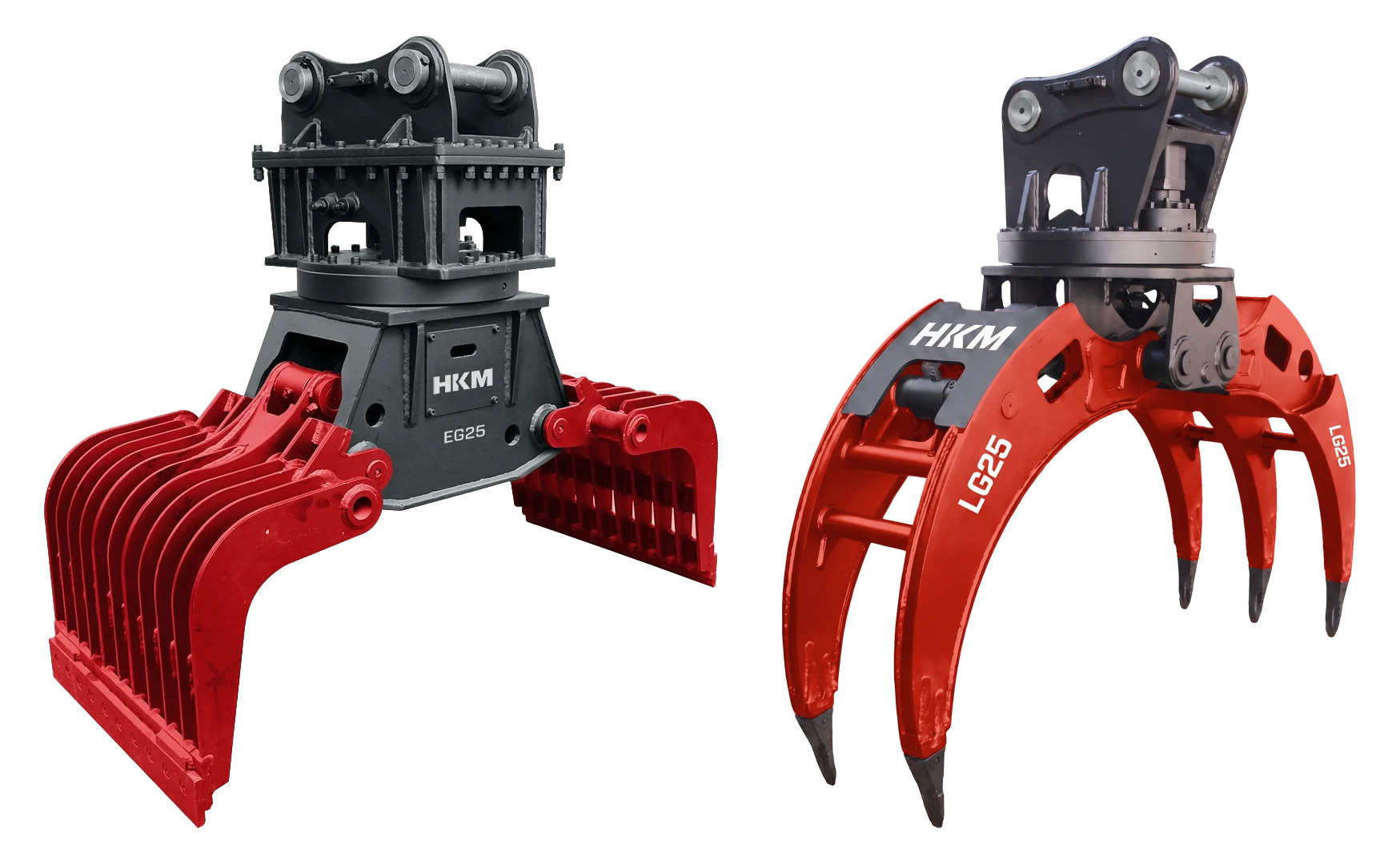
Grapples are handling and sorting attachments mounted on the end of the excavator stick that grip material between opposing jaws and, thanks to a hydraulic rotator, turn the load in the air and set it down in the position you want. Two types are the most common on site: the sorting grapple speeds up separating the target piece out of mixed material on recycling and demolition sites, and lets an element being taken down reach the ground safely during selective removal; the log grapple picks felled trunks off the ground in forestry, loads them onto the vehicle and lays them out in the stack. Because it holds material piece by piece or in bundles rather than digging like a bucket, it reduces both the manual sorting workload and the damage caused by free dropping.
What sets a grapple apart from other attachments is that the operator can control grip force and jaw position continuously. The hydraulic rotator turns the load to the right angle without repositioning the carrier; fragile material is held with less squeeze, while heavy, slippery pieces are held with the jaws fully closed. This control protects the sound parts of the surroundings as well as the value of the material being handled, whether scrap or timber. When the jaws close fully, even small pieces are held safely; handling with a half grip lets the load slip and causes damage around it.
On this page we describe how a grapple is actually used through three applications: sorting waste by type on a recycling site, selective removal and debris management in demolition and restoration, and collecting and stacking timber in forestry and landscaping. In each section you will find the job preparation, the working method and the cases where a grapple is not the right choice.
Recycling
Sorting mixed waste by type on the recycling site
The work starts with the site layout. Separate stockpile areas or containers are set out for concrete, metal, timber and mixed waste, and the carrier is placed where it can swing between the pile and the discharge points with the least maneuvering. The sorting grapple is fitted with the quick coupler and the hydraulic lines are connected; jaw and rotator movements are tried out without a load to check them. At the start of the shift, wear on the jaw tips and leaks at the hydraulic connections are inspected by eye; this short check prevents unplanned stoppages during the day.
The operator starts at the top of the pile and takes the large, easily separated pieces first: steel sections and lengths of rebar go to the metal area, timber elements to their own pile, clean concrete pieces to the grinding line. The rotator turns the gripped piece over the right container without the carrier moving from its position; long pieces are laid into the container parallel to its axis so the volume is used efficiently. The output of this flow is clean fractions that feed the next step: metal is set aside as scrap, concrete goes to the pulverizer or the crusher bucket as uncontaminated material, and the value of the recovered product rises.
In this flow the grapple takes on selecting and handling, not breaking. Reducing large reinforced concrete pieces is the job of the concrete cutter and the pulverizer, and turning concrete into aggregate is the job of the crusher bucket. A grapple is also inefficient in fine grained, free flowing material; the right approach is to move that kind of material with a bucket and keep the grapple for pieces that can be picked.
- The site is divided into separate stockpile and container areas by material type.
- Work starts at the top of the pile; large, easily separated pieces are taken first.
- The load is turned with the rotator and released over the right area without repositioning the carrier.
- Long pieces are laid into the container parallel to its axis.
- The clean fractions that come out are fed to the pulverizer, shear or crusher bucket line.
A common mistake: trying to tear pieces free with the grapple
Trying to wrench a piece jammed in the pile loose by twisting the grapple or backing the carrier up damages the rotator and the jaw bearings. A piece that will not come free is left alone; cutting or breaking it is handed over to the shear or the pulverizer.
Demolition & Renovation
Securing the element being removed and lowering it under control
In selective removal the aim is to take the target element without harming the parts of the structure that stay. The work plan sets out which beam, roof element or cladding panel comes down in which order; the carrier is placed where it can grip the element and see the landing area. The critical rule is the sequence: the element is first gripped with the grapple and made secure, and only then is its connection cut or released, so the piece is never loose at any moment.
The grip point is chosen close to the element's center of gravity; the rotator carries the piece over the landing area in a tight swing and sets it down flat on the ground. In built up areas this method produces markedly less dust, noise and scatter than free demolition; working without blasting and with low vibration gives confidence close to adjoining buildings. The elements brought down are separated by type with the same grapple and carried to the loading area; manual sorting on site falls and the debris flows into the recovery line in an orderly way. In restoration the same approach is used to take cladding and roof elements safely off the building while working around facades and load bearing systems that have to be preserved.
A grapple is not the tool for every stage of demolition. Primary demolition of reinforced concrete walls and slabs belongs to the breaker, and cutting steel frames to the shear; the grapple is the link that clears the way for these attachments and tidies up behind them. Trying to grip and pull down a heavy reinforced concrete mass that is still in place both strains the jaws and reduces control; the right flow is to cut and reduce the element first, and use the grapple for lowering and sorting.
- The lowering order and the grip point for each element are set in the work plan.
- The element is gripped first and its connection cut afterwards; the piece never falls free.
- A tight swing is made with the rotator; the load is not carried over people or machine traffic.
- The piece is laid flat on the ground; the risk of it toppling or bouncing is avoided.
- The elements brought down are separated by type with the same grapple and carried to the loading area.
The critical distinction: lowering versus tearing free
A grapple lowers an element that has been cut or released; it is not designed to tear an element out of place. Pulling on a piece that is still connected destabilizes the carrier and strains the jaw bearings; where breakout force is needed, the concrete cutter or the shear takes over.
Landscaping, Agriculture & Forestry
Collecting, turning and stacking neatly on the timber line
In forestry the grapple's job is to pick up felled timber, load it onto the haulage vehicle or lay it out in the stack. The jaws of a log grapple are shaped to wrap around a cylindrical trunk; gripped close to the center of gravity, the load stays balanced and the ends do not swing. The rotator is decisive here: the gripped log is turned in the horizontal plane in the air and lined up with the stack direction, which largely removes the need for the carrier to shunt back and forth. Before collection the route is looked over, the points where logs are jammed together are identified, and the stacking area is set up on level ground the haulage vehicle can pull up to.
The stack is built from the bottom up in orderly rows, each log left in the same direction as the last and with the ends aligned. Thin branches, brush and pruning waste are gripped in bundles and carried to the collection point; for clearing an area this is both faster and safer than picking up by hand. On the landscaping side the same attachment handles stumps, places rocks and clears the site; thanks to the quick coupler, a carrier boring holes with an auger is back on gripping work in a short time, and a small crew runs several jobs with one machine.
A log grapple does not fell standing trees and does not pull stumps; felling belongs to the chainsaw or the harvester, and stumps and hard ground to the ripper. On soft, wet ground tight turns with a heavy log can strain the carrier; in those conditions, working in short carries rather than dragging the load keeps ground damage low.
- The log is gripped close to its center of gravity so the ends do not swing.
- The log is lined up with the stack direction using the rotator, reducing carrier maneuvering.
- The stack is built from the bottom up in single direction rows with the ends aligned.
- Branches and brush are gathered in bundles and carried in one go.
- On wet ground, short carries are preferred so the surface is protected.
Site note: carry it, do not drag it
Dragging a log along the ground puts side loads on the jaws and the rotator, and damages both the bark and the ground surface. The load should be gripped fully and lifted; a piece that cannot be lifted should either be cut down or handled with a carrier of the right class.
Frequently Asked Questions
Where is a grapple not the right choice?
A grapple is a gripping and handling attachment; it is not used for breaking, cutting or grinding. Reducing reinforced concrete is the pulverizer's job, cutting steel the shear's, and turning concrete into aggregate the crusher bucket's. In fine grained, free flowing material, and with single pieces beyond its capacity, a bucket or equipment of the right class should be chosen instead of a grapple.
What is the correct sequence when working with a grapple in selective removal?
The element is first gripped with the grapple and made secure, its connection is then cut or released, and the piece is lowered under control. This sequence prevents the piece falling free, prevents damage to the sound parts around it and stops debris scattering.
What does a hydraulic rotator gain you on site?
The rotator turns the gripped load to the right angle without the carrier moving from its position. In sorting, the piece is lined up over the right container; in forestry, the log is lined up with the stack direction in mid air. With less maneuvering the job finishes sooner and ground damage falls.
Can a grapple be used in built up areas or in a confined space?
Yes. A grapple works without blasting and with low vibration; because it grips and lowers the element instead of dropping it free, dust, noise and scatter are reduced. In a confined space the rotation the rotator provides keeps the carrier's need to maneuver to a minimum.
Related Applications
Get access to the HKM Dealer Portal
Access pricing, stock availability, spare parts, and technical resources. Apply now to benefit from HKM privileges designed to strengthen your business and operations.