
Pulverizers
Where and How Are Pulverizers Used?
How fixed, rotating and magnet equipped pulverizers are actually run on demolition and recycling sites, told at the level of working method.
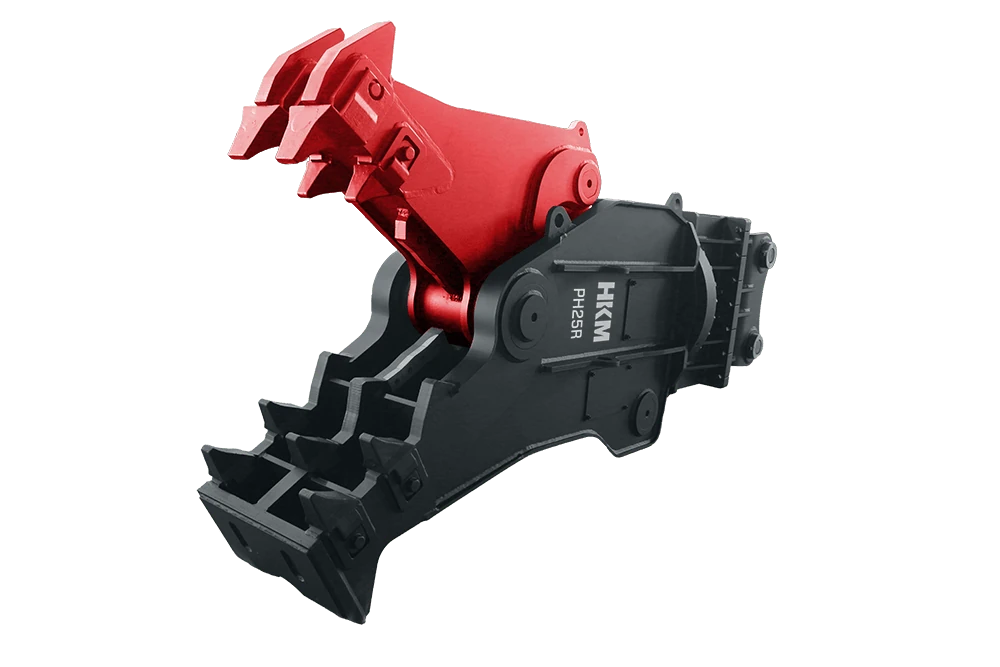
A pulverizer is a hydraulic attachment fitted to the excavator stick that takes reinforced concrete between two opposing jaws and grinds it under compression. As the concrete is crushed and falls away between the jaws, the rebar inside it is stripped out without being cut; what comes out is two separated materials, concrete suitable for recovery and steel that can be sold as scrap. That is why the pulverizer belongs not to demolition itself but to the separation stage that follows it. Its main applications are secondary processing in the dismantling of reinforced concrete buildings and industrial structures, cleaning ahead of the crushing line on a recycling site, and impact free processing on jobs inside built up areas.
Three types are distinguished on site, and that difference shapes how the job is set up. A fixed pulverizer mounts directly to the stick, its jaw stays within the plane of the stick, and it is a secondary attachment used to grind debris that is already on the ground. On the rotating type the jaw sits on a hydraulic head that turns through three hundred and sixty degrees; because the element can be entered at the right angle without repositioning the carrier, it also works as a primary attachment on elements at height and on narrow facades. The magnet type carries a magnet unit mounted on the body, and the stripped rebar is collected with the same attachment as soon as the crushing stops; the separate collection step and the attachment change both disappear.
Below you will first find the job preparation, the operator's working routine and where the output goes on demolition and restoration sites and on recycling sites. Then we go into the attachment itself: what each part does, how gripping and crushing habits determine service life, and where the maintenance decisions are made. In every section we have covered the cases where the pulverizer is the wrong choice as well as those where it is right.
Demolition & Renovation
Secondary processing and rebar stripping on the demolition site
In demolition the pulverizer has a clear place in the order of work: it comes in after the structure has been broken into pieces with a hydraulic breaker or a concrete cutter. Preparation starts with deciding where the crushing will be done. Working while the pieces lie scattered around the carrier lengthens the cycle and blocks the operator's view; instead, column, beam and slab pieces are collected in a single crushing area in front of the carrier. The ground of that area has to be hard and level, because the piece reacts against the ground as the jaw closes. If elements are to be taken from height with a rotating type, the drop zone is cleared, the carrier's reach and load curve are checked, and the hose run is secured along the boom.
The operator grips the piece not with the tip of the jaw but with the deep section close to the pivot; this is where the force is highest and where the jaw takes no side load. On slab and wall pieces the work starts at the edge: the first bite is set on the free edge of the section, the concrete is broken away, the jaw opens and a step is taken into the piece for the next bite. Progress therefore follows the rebar mat, and successive bites strip the bars out of their concrete cover. The crushing direction is kept parallel to the axis of the rebar; closing the jaw across the bars cuts the rebar instead of stripping it and shortens the scrap unnecessarily. On the rotating type the head is turned while the jaw is free, so the section can be entered at the right angle; rotation is not used while crushing is under way.
The output is two separate piles: rebar clean of concrete residue, and concrete with its steel removed. The first goes straight to the scrap line, the second is fed as clean material to a crusher bucket or to a fixed crushing plant. Where the pulverizer is the wrong choice is equally clear. Bringing down a standing solid wall or a foundation mass is the job of the breaker and the concrete cutter; the pulverizer cannot make progress in a mass that will not fit its jaw. Cutting heavy steel sections, columns and plate belongs to the hydraulic shear. Bringing debris down to a defined particle size is likewise the business of the crusher bucket, not the pulverizer.
- Set up the crushing area at a single point on hard, level ground in front of the carrier.
- Grip the piece with the deep part of the jaw near the pivot, not with the tip.
- On slabs and walls start at the edge and step into the section with every bite.
- Keep the crushing direction parallel to the rebar axis so the bars are stripped, not cut.
- Keep stripped rebar and clean concrete in separate piles as the work goes on.
Do not crush on top of the pile
Crushing a piece where it sits on top of the debris spends part of the force compacting the pile, and the piece slips at every bite. Bringing the piece down onto hard ground first finishes the same job with markedly fewer bites.
Recycling
Producing a clean fraction on the recycling site
On a recycling site the pulverizer is positioned immediately ahead of the crushing line. The work begins with sorting the incoming pile: timber, plastic and insulation material are pulled out with a grapple, because they do not crush, they behave like a cushion between the jaws and waste the bite. The pile is then divided in two: reinforced pieces go to the pulverizer line, plain concrete and brick go straight to the crushing line. When the floor of the crushing area is concrete or compacted fill the piece does not slide, so the cycle stays short. The fixed type is enough in this arrangement; because the attachment works at the same height and in the same direction all day, the rotating head adds little.
The operator pulls the piece into the crushing area and grips it across the narrowest dimension of the section; in the narrow direction the concrete offers less resistance and the rebar mat is exposed early. On long slab strips the work starts at one end and is walked along the strip. If the concrete that falls away is not cleared, it gets under the next bite and lifts the piece, so the crushing area is cleaned at intervals. With the magnet type the job is one step shorter: once crushing is finished the magnet unit is switched on, and the stripped bars together with the fine tie wire left in the concrete are collected with the same attachment and dropped into the scrap container. The magnet is used to sweep the surface of the crushed material, not to dig into the pile.
The output of this flow is concrete that will enter the crushing line free of steel, and scrap steel that can be sold on its own. The quality of the separation shows directly in the productivity of the next step: pieces with bars still in them wrap around the mouth of the crusher bucket or the crushing plant and create downtime. The pulverizer has its limits here too. Bringing the concrete that comes out down to a defined particle size is not its job; sizing belongs to the crusher bucket or to the fixed plant. A mixed scrap pile containing heavy sections and sheet is the shear's field. Wet, clayey and sticky material needs draining rather than crushing.
- Sort timber, plastic and insulation material out of the pile first.
- Split reinforced and plain pieces into separate lines.
- Grip the piece across the narrowest dimension of the section.
- Clear the crushing area of fallen concrete at intervals.
- With the magnet type, collect with the same attachment as soon as crushing stops.
The quality of the separation is the speed of the next line
Concrete with a few bars still in it can turn into a long stoppage on the crushing line. Stripping the rebar fully during crushing is both faster and cheaper than sorting it out afterwards.
The parts of a pulverizer and what each one does
A pulverizer is made up of few parts, but each of them governs a particular aspect of how it behaves on site. The list below also shows where to look when output drops.
- Jaw geometry
- The pulverizer jaw is wide and concave; instead of concentrating force on a narrow line it spreads it over a large surface of the piece, and the concrete cracks from within under that distributed pressure. The opening of the mouth decides what thickness of piece can be gripped, and its depth decides how close the piece can get to the pivot. Because the force rises as you approach the pivot, the deep part of the mouth is the real working area of the jaw.
- Tooth plates and wear liners
- The inner face of the jaw is not bare; it carries bolted or welded tooth plates and wear liners. The teeth grip the piece and stop it slipping, and the liners protect the jaw body from the abrasion of concrete and rebar. These are parts that are sacrificed deliberately: they are fitted so that the wear happens on them rather than on the body.
- Rebar cutting section
- On most models there is a cutting section at the root of the jaw dedicated to shortening stripped rebar. It is there to bring the scrap down to a size that can be handled. When a heavy section is forced into this area the blade edge cracks, and the attachment also loses ground on crushing, which is its real job.
- Cylinder
- The hydraulic cylinder that closes the jaw is housed and protected inside the body; the crushing force comes from it. If you see scoring on the rod, leakage around the body or irregular movement on closing, carrying on working will only make the damage worse. Closing force and speed values by model are given in the manual.
- Speed valve
- Many models have a speed valve that lets the jaw close quickly under no load. Until the jaw touches the material the valve routes return oil to the piston side and gives fast movement at low force; when resistance rises and the pressure builds, the arrangement switches into high force mode by itself. That shortens the idle part of the cycle. On site you can tell the valve is there from the way the jaw closes noticeably fast until it meets the material.
- Rotating head
- On the rotating type the jaw sits on a hydraulic head that turns through three hundred and sixty degrees and is fed from a separate line. The gain is in positioning: the element can be entered at the right angle without moving the carrier. The rotary coupling inside the head passes the oil through without winding up the hoses; this area is the most sensitive part of the pulverizer.
- Magnet unit
- On the magnet type a magnet mounted on the body is used to collect stripped rebar and fine wire. The supply arrangement and the way it is controlled vary by model; confirm from the manual or with us whether your carrier suits it. Its value on site is that it removes the attachment change between crushing and collecting.
A speed valve is not a power valve
The speed valve shortens the idle part of the cycle; it does not increase crushing force. The moment the jaw touches the material the arrangement is already in high force mode, and forcing the control gains nothing. A jaw that cannot break up the piece it has gripped needs a better gripping point, not a faster one.
Operator habits: gripping, crushing and stripping
With a pulverizer, output depends less on force than on the choice of gripping point. The same attachment finishes the same piece in a few bites when it is gripped in the right place, and never finishes it at all when it is gripped in the wrong one.
The grip is always taken across the narrowest dimension of the section and in the part of the jaw close to the pivot. The far face of the piece has to be bearing on something: the ground, another piece of debris, or a section still standing. A piece with nothing behind it escapes as the jaw closes and the bite is wasted. Every time the jaw opens, a step is taken into the piece, and the concrete that has fallen away is cleared so it cannot get under the next bite.
The rebar is stripped by the crushing itself. The bar is not cut; successive bites break away the concrete cover around it and the bar comes free. Making progress therefore means following the direction of the rebar mat. If an element is being taken from height, the gripping point is chosen with respect to the center of gravity of the piece; you have to know in advance where the piece will fall when the jaw opens.
- Do not try to tear off a piece you have gripped by pulling with the boom; the force has to be in the closing direction of the jaw.
- Do not use the pulverizer as a lifting or carrying device; moving pieces is the grapple's job.
- Do not slew the carrier or move the boom before the jaw has fully closed.
- Do not turn the rotating head while the jaw is under load.
- Do not bite with the tip of the jaw; crushing from the tip is slow and concentrates the wear in one area.
- Do not start on a mass that will not fit the jaw; bring the mass down with a breaker or a concrete cutter first.
If the bite is wasted, change the position, not the piece
If the concrete is not breaking up, the first place to look is the gripping point: has the piece ended up at the tip of the jaw, is its far face unsupported, was it gripped across the wide dimension of the section. The answers to those three questions usually restore progress without changing the attachment.
Maintenance: what to change and when
- Tooth plate and liner replacement
- Tooth plates and wear liners do not wear evenly inside the jaw; the area that meets the material first always goes ahead of the rest. That is why the plates are handled as a set rather than one at a time, so the wear stays balanced. On symmetrically designed plates part of the service life is recovered by taking the plate off and turning it round. On bolted fixings the tightening torque is specific to the model and is taken from the manual; a plate that works loose eats its own seat.
- Rebar cutting blade
- The cutting blade at the root of the jaw is designed so that it can be taken off and turned round for further use once the edge has gone dull. Whether the blade can be built up by welding depends on the blade material; on a hardened blade, uncontrolled heat input starts a crack. Do not make that decision without consulting the manual or us.
- Pin and bushing lubrication
- The pins and bushings at the jaw pivot are the point that carries the highest load. Greasing is done with the jaw free and the pivot unloaded; grease applied under load does not reach the bearing surface that actually needs it. Growing play at the pivot makes the jaws close out of line, and the first sign of this is that the two mouths no longer meet when the jaw is closed.
- Rotating head maintenance
- The rotating head is both where the oil passes through a rotary joint and where the weight of the attachment hangs. If there is leakage around it, binding in rotation or uneven speed, work is stopped. The daily check is a visual one: that the hose runs do not wind up through the rotation, that the fixings have not worked loose, and that the rotation is even in both directions.
- Keeping the hydraulic side clean
- A pulverizer works in debris, and the attachment change is made in a dusty environment. Couplings are wiped before they are disconnected and reconnected, and open ends are protected with caps. Dust that gets into the hydraulic system does not show its damage at once but over time; a seal that starts to leak or a jaw that slows down is usually the result of dirt that got in weeks earlier.
Plan replacement before the wear limit arrives
Changing tooth plates and liners is a few hours of work when the parts are on the shelf; when they are not, it means the site stands still. Tying consumable tracking to the shift record turns the change from unplanned downtime into planned work.
Frequently Asked Questions
Do you start with the standing structure or with the debris on the ground when working with a pulverizer?
A fixed pulverizer is for debris that is already on the ground; it is not designed to dismantle a standing structure. A rotating type can also work as a primary attachment on column and beam sections that fit its own jaw opening, but on solid walls and foundation masses the breaker or the concrete cutter still comes first. The general rule is to bring the mass down to a size that can be gripped, and to keep the pulverizer for the separation stage.
How do you know the rebar has been stripped clean?
If no concrete cover is left on the surface of the bar and the bar hangs free when the jaw opens, the stripping is complete. If enough cover is left between the ribs to affect the value of the scrap, a second bite is taken in the same area. Keeping the crushing direction parallel to the rebar axis largely removes the need for that second bite.
How should the rotating head be used on site?
Rotation is for positioning: the angle to the section is set while the jaw is free, and rotation is left alone once the grip is taken. Trying to tear off a gripped piece by turning it puts a torsional load on the rotating head that it was not designed for. The hose runs are checked every shift; a hose that has wound up is usually noticed in the middle of a rotation, and by then the damage has started.
How is the fall of a piece controlled when taking an element down from height with a pulverizer?
The gripping point is chosen close to the center of gravity of the piece, and the drop zone is cleared before work starts. Once the element is broken free it is not released; it is lowered with the jaw kept closed and laid flat on the ground. If the piece is heavier than the jaw can hold, it is reduced along the section first. Weight and reach limits are read from the carrier manufacturer's load curve.
Related Applications
Get access to the HKM Dealer Portal
Access pricing, stock availability, spare parts, and technical resources. Apply now to benefit from HKM privileges designed to strengthen your business and operations.