
Drum Cutters
Where and How Are Drum Cutters Used?
An application guide that explains, at method level, how a transverse drum cutter mounted on an excavator is actually run on site, from mining to foundation work.
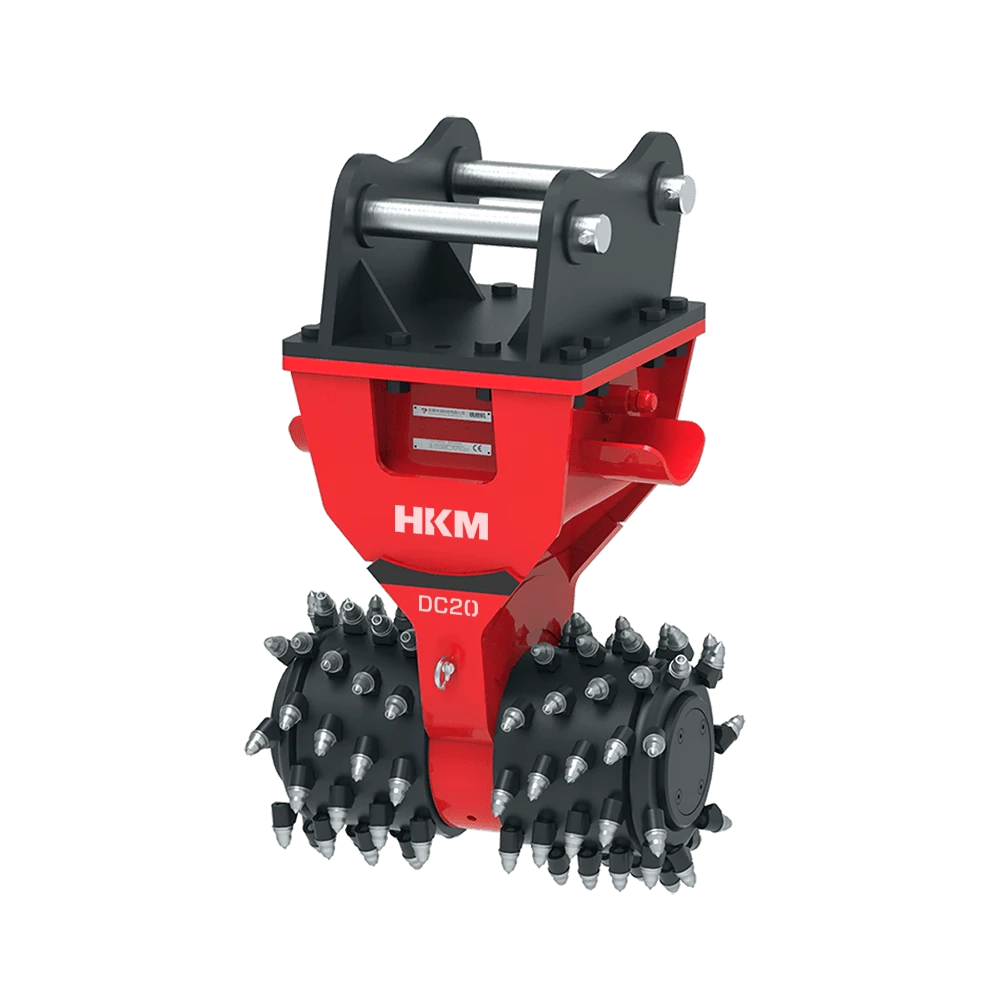
A drum cutter is a hydraulic attachment mounted on the excavator stick that mills rock, concrete and hard ground with the picks on its rotating drums. Unlike impact driven equipment, it removes material layer by layer with a continuous cutting action, which means low vibration, an even surface and precise profile control. Blast-free excavation, slope and wall shaping, tunnel profile trimming, surface milling, layer removal in restoration and cutting narrow trenches in rock are the main applications of this attachment.
In the transverse design the drums sit perpendicular to the axis of the stick and meet the surface along a wide contact line. The operator manages cutting depth through the down pressure of the boom and stick and through feed speed; a steady feed that matches the drum's own cutting rhythm determines both surface quality and pick life. Because the cuttings come off fine and uniform, on most sites they go straight into fill without any further crushing.
In the sections below you will find how a drum cutter is actually run in different applications: the job preparation, the method steps and the conditions under which another attachment would be the better choice.
Mining & Quarrying
Blast-free production and bench layout in the quarry
In quarries where a blasting permit cannot be obtained, or that sit close to settlements or structures that must be protected, the drum cutter becomes the primary production tool. Before work starts the formation is assessed: bedded, fractured rock of medium hardness is the most productive structure for milling. The carrier is set up on firm, level ground, and both the bench face to be worked and the target slope profile are marked out in advance.
The operator brings the drum onto the surface from above and works down layer by layer, sweeping the rock face in overlapping strips. The cutting direction is chosen to take advantage of the bedding planes and the joint system, so the picks strip the rock along its weak planes instead of being forced to break it. Since the cuttings come off fine and evenly sized, they are loaded out directly and a separate sizing step is usually unnecessary.
A clear boundary has to be drawn: in massive, very hard rock with few fractures, milling slows down and pick consumption climbs quickly. In such formations a heavy class hydraulic breaker, or drilling and splitting methods, can be more economical; on those sites the drum cutter works less on production and more on slope trimming and precision finishing.
- The bench face is milled from the top down in overlapping strips.
- Cutting direction is set according to the bedding planes and the joint system.
- The target slope profile is marked in advance and checked often during the passes.
- The fine cuttings are loaded out directly, with no intermediate crushing.
Over-pressing is the most expensive mistake
The most common mistake on site is raising boom down pressure to speed up progress. When the drum is pushed beyond its own cutting rhythm the picks look like they are cutting but are really rubbing; they go blunt early and the hydraulic motor is strained. Steady, balanced pressure always delivers a faster result.
Earth-Moving & Infrastructure
Milling trenches along pipe and cable routes
For water, gas, power and fiber lines laid in rocky ground, trench width is set directly by the cutting width of the drum; on hard routes that a bucket cannot open, the drum cutter produces a narrow, clean trench profile with straight walls. Before work begins the route is marked out and existing utility lines are located; because milling advances under control, cutting depth is reduced in stages as known lines are approached.
The carrier is positioned on the trench axis and works backwards along the line, with the operator taking the trench one layer deeper on each pass. Working in shallow, quick layers rather than trying to reach full depth in a single pass improves both progress and surface evenness. Because the trench walls are milled, no extra trimming is needed, and the invert comes out flat enough for the pipe bed.
In soft soil a drum cutter is unnecessary; a standard bucket is faster. Fill ground containing large concrete lumps, rebar or mixed debris also calls for care: buried steel can damage the picks. On routes like these the overburden is stripped with a bucket first, and the cutter only comes in on the hard layer.
- The route is marked out and existing utility lines are located beforehand.
- The trench is deepened in shallow layers with successive passes.
- Cutting depth is reduced in stages as known lines are approached.
- Where it meets the specification, the milled output is reused as trench backfill.
Do not open the trench with bucket logic
With a cutter the trench is not torn open in one go the way a bucket does it; it is swept open layer by layer. Diving deep on a single pass jams the drum, stops progress and puts point loads on the picks.
Tunneling & Underground
Underground practice in profiling and scaling work
In tunneling the drum cutter's real job is bringing the excavated cross section back to the design profile. After blasting or mechanical excavation, anything left standing proud of the profile is trimmed off with the drum, and loose material on the crown and walls is taken down under control (scaling). Before work starts the target profile is set out with a template or markings, and the ventilation and dust suppression arrangements are made ready.
In a confined environment low vibration is decisive: impact equipment can shake the surrounding rock and the support already in place, whereas the cutter takes rock off the surface and leaves the main mass undisturbed. The operator runs the drum along the profile line, thins the overbreak from the outside in and stops on the target line. The same approach is used on the invert; the surface is leveled without spoiling the drainage fall.
In a hard, massive rock face it would be wrong to rely on the drum cutter alone for primary advance; under those conditions the cutter takes a supporting role alongside breakers and drilling methods. In weak to medium strength rock, on the other hand, both advance and profile work can be carried out with the same attachment.
- The design cross section is turned into a profile line with a template or markings.
- Overbreak outside the profile is thinned from the outside in.
- Loose material on the crown and walls is swept off from the top down.
- Dust is suppressed at source with water spray and ventilation.
Scaling is not a job for the breaker
Clearing loose material with impact equipment can shake new loose zones into being. Because the cutter takes the piece by cutting around it, the remaining surface stays sound; in surface preparation before support is installed, this distinction is critical.
Demolition & Renovation
Stripping layers from the surface and selective removal technique
In restoration the aim is to remove only the problem layer, not the structure. Before work starts the sections to be preserved are marked and the boundary of the layer to be removed is set; decayed concrete, blown plaster or weathered facing is stripped in thin passes until sound material appears underneath. The drum is brought onto the surface at a shallow angle and run in wide, overlapping strips, each pass taking a thin layer.
This method has two important outcomes. First, since the remaining section takes no impact, no cracks form and the load bearing system of the building is not disturbed. Second, because the milled surface comes out rough, repair mortar and new concrete bond strongly to it. In buildings that share walls with their neighbors, the low noise and vibration also creates room to work in terms of permitted hours and neighborly relations.
Where full structural demolition is the task, the drum cutter is the wrong choice; for bulk demolition a hydraulic breaker, shear and pulverizer are far quicker. In that workflow the cutter comes in at the boundary of the parts to be kept and on delicate surface work.
- Sections to be preserved and the layer boundary are marked before work starts.
- The surface is stripped in overlapping strips, taking a thin layer on every pass.
- Reaching sound concrete is recognized from the change in surface color and cutting behavior.
- Before repair, the surface is left rough as milled and ready for bond.
Once rebar appears the method changes
A drum cutter cuts concrete, not rebar. When steel is exposed during stripping, forcing on with the cutter damages both the picks and the bars; work on the steel continues with a shear or pulverizer, while the cutter carries on in the concrete around the bars.
Foundation Works
Level, invert and surface preparation in the foundation pit
In foundation work the value of milling lies in precision: hard rock in the base of the excavation is taken down to the target level layer by layer and the invert is left even at handover level. Before work starts the level marks are set out and the edge of the pit is made safe; the carrier stands at a safe distance from the pit edge or works inside the pit on a suitable ramp.
Retaining and foundation wall faces are swept in the vertical direction to straighten them, giving an even surface for anchoring and waterproofing. In pile cropping the cutter takes the excess concrete off the pile head in stages without disturbing the reinforcement; as the bars are exposed, the concrete around them is thinned and the steel is left clean for the connection that follows.
In soft ground that will not stand on its own there is no need for a cutter; a bucket is enough. In deep excavation through completely massive rock, the cutter should not be planned as the main excavation tool on its own; the breaker should take the bulk excavation while level and surface accuracy are left to the cutter.
- The target level is marked out and the invert is brought down to it layer by layer.
- Retaining and wall faces are swept vertically and made ready for waterproofing.
- At the pile head, concrete is thinned back from around the reinforcement in stages.
- Bulk excavation and precision finishing are split between breaker and cutter.
What leveling the invert with a breaker costs
Leveling with impact equipment usually means overbreak below the target; the voids that result then have to be made up with extra concrete or fill. Because the cutter can stop exactly at the target level, that cost never arises.
Frequently Asked Questions
Where is a drum cutter not the right choice?
It is inefficient for primary excavation in massive, very hard rock with few fractures; progress slows and pick consumption rises. In soft soil a bucket is faster, and in heavily reinforced sections the steel calls for a shear or pulverizer. The cutter is the tool for work that demands a precise profile, low vibration and a clean surface.
What should the operator watch when working with a drum cutter?
The most critical point is down pressure: the drum should be advanced at its own cutting rhythm and never forced. Working down in layers, choosing the cutting direction to suit the formation, checking pick condition regularly and suppressing dust with water spray all bear directly on output and equipment life.
How is a drum cutter used inside a tunnel?
It is used to trim overbreak left outside the profile after excavation, to take down loose material on the crown and walls (scaling) and to level the invert. Because it works with low vibration, it brings the cross section to the design profile without shaking the surrounding rock or the support already in place.
What is done with the material produced by milling?
A drum cutter delivers material at a fine and uniform size; on most sites that output can be reused as fill or sub-base without further crushing. Suitability should be confirmed by the site team according to the material type and the fill specification of the project.
Get access to the HKM Dealer Portal
Access pricing, stock availability, spare parts, and technical resources. Apply now to benefit from HKM privileges designed to strengthen your business and operations.