
Quick Couplers
Where and How Are Quick Couplers Used?
A guide to turning the quick coupler into productivity on site: typical attachment rotations by sector, changeover station layout and lock verification discipline.
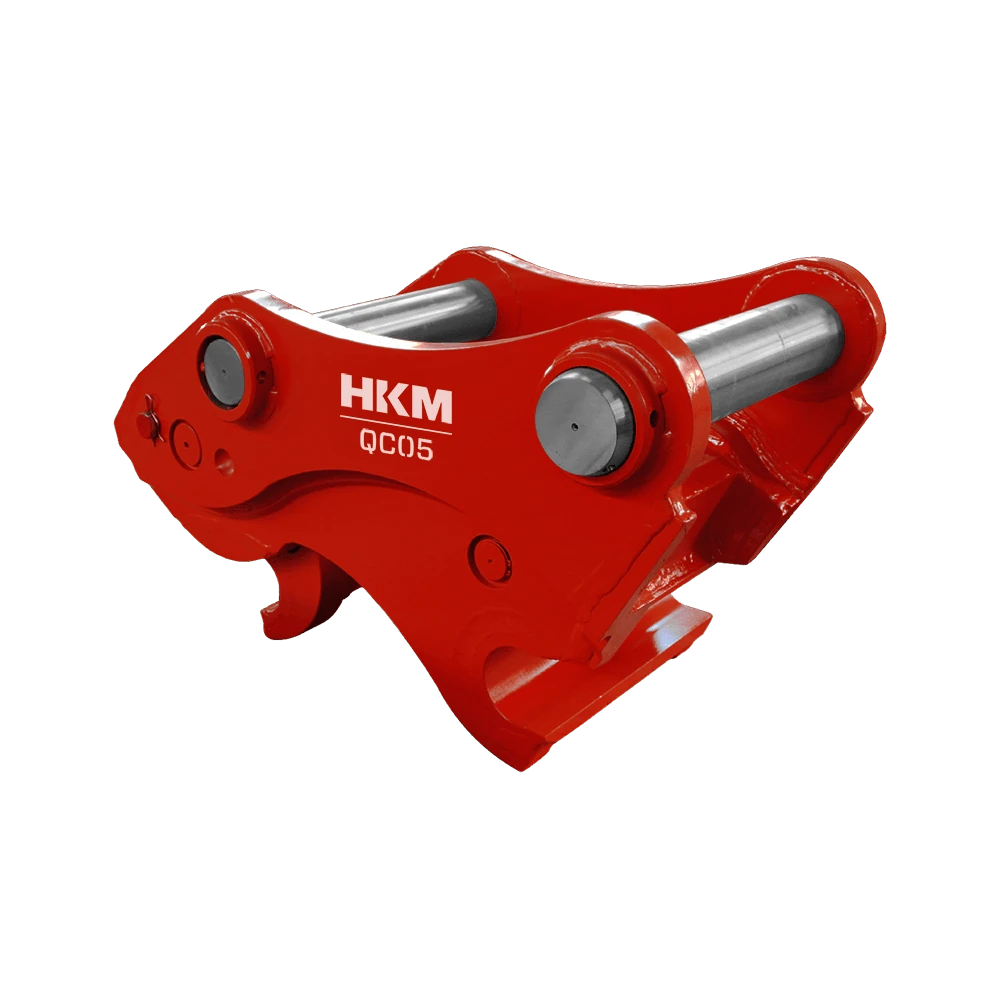
A quick coupler is an intermediate connection element mounted between the excavator stick and the attachment, letting the machine change between equipment such as breakers, buckets and augers in seconds. With mechanical attachments like buckets the whole change is managed from the operator's cab; with hydraulically fed attachments such as breakers, the hose connection may still have to be made by hand, depending on the coupler type. Compared with the traditional method of knocking pins out and back in by hand, it shortens changeover time considerably, keeps the operator from having to go under suspended equipment, and lets the same carrier take on several different jobs in a day, which raises machine utilization.
The real value of a coupler shows up not in a single change but across the whole workflow. In a work plan built on several attachments, the digging, breaking, boring, cutting and sorting steps are sequenced on one machine; the need for a second carrier, or for extra staff coming down to ground level for attachment changes, falls away. On this page we describe how the typical attachment rotation is built in five different applications, how the changeover point is prepared and when a coupler is unnecessary.
Whatever class of carrier you work with, the productivity you get out of a coupler depends largely on discipline: parking attachments on level, firm ground, verifying the pin safety lock after every change and keeping the connection faces clean are the three legs of that discipline. Without those habits, the time gained can turn into breakdown and safety risk.
Earth-Moving & Infrastructure
Bringing digging, breaking and boring together on one carrier along the trench
In utility and pipeline work the ground is rarely uniform: soft fill, hard layers, rock bands and existing services follow one another along the same route. On an excavator with a quick coupler the typical rotation is built around a bucket, a hydraulic breaker and a hydraulic auger. In job preparation these attachments are parked at a changeover point that travels along the route, on level, firm ground within easy reach of the carrier; as the line advances, the changeover point moves with it.
The working cycle starts with digging: the trench is opened with the bucket, and when a hard layer or rock band is reached the lock is released from the cab, the bucket is set down and the breaker goes on. The broken material is lifted out with the bucket again and the trench profile is completed. Changing to the auger for pole and sign holes along the route follows the same routine. The pipe crew does not wait for the machine, the trench line advances without interruption, and the need to keep a second machine on site purely for breaking is reduced.
This arrangement makes sense on jobs where the attachment is changed several times a day. If the whole route is uniform ground and the machine will do nothing but dig for weeks, the weight and length the coupler adds bring no extra benefit; in that case a direct pinned connection is a valid choice too.
- Park the attachments at a single changeover point that travels with the route, on level ground.
- Read the ground profile in advance; plan the change to the breaker before you hit the hard layer.
- After every change, verify the lock visually and by pressing the attachment against the ground.
- Sequence the digging, breaking and boring steps in the same shift with one operator.
A common mistake on site
Leaving an attachment on sloping or loose ground. Picking up an attachment that has tipped or slid wastes time and can damage the connection faces; the changeover point should always be level, firm ground.
Mining & Quarrying
The cycle after blasting in the quarry: breaker, ripper and bucket in turn
In quarries and open pits the role of the quick coupler is to bring the cycle after blasting together on a single carrier. A hydraulic breaker for secondary breaking of large blocks, a ripper for blast-free loosening of bedded or weathered zones, and a bucket for collecting the broken material and feeding the plant all work in turn on the same machine. The attachments are parked at a separate station, outside the line of rockfall from the face and the slope being worked.
The shift plan is built around the attachment rotation: the first part after the blast is heavy on block reduction with the breaker; once the material flow settles, feeding with the bucket and cleaning the floor come to the fore; and when weathered zones are reached the ripper comes in. Because the operator manages these changes from the cab, the machine does not stand idle, and the crew does not walk into the machine's working area on rough quarry ground to change attachments.
Abrasive dust and rock chippings define this environment; cleaning the connection pockets at every change and greasing regularly are preconditions for the lock seating fully. On machines dedicated to a single job, where the breaker will stay on for long periods, a coupler is not essential; with no rotation, a direct connection can be enough.
- Set the attachment station outside the line of rockfall from the face and the slope.
- Tie the rotation to the shift plan: separate the breaking, feeding and loosening slots.
- Clean the pin pockets at every change and keep the greasing routine going.
- Verify the lock by pressing the attachment against the ground, without going under the load.
The critical distinction
In a pocket packed with dust and chippings the lock can look closed without being fully seated. In a quarry environment a visual check on its own is not enough; pressing the attachment against the ground after every change should be a standard habit.
Demolition & Renovation
One machine from dismantling to sorting on the demolition site
Demolition is not a single kind of work: selective removal, primary demolition, secondary reduction and debris sorting on the same building all call for different attachments. A quick coupler ties these steps to one carrier: dismantling with a concrete cutter or shear, breaking slabs and walls with a hydraulic breaker, separating rebar with a pulverizer, and sorting and loading with a grapple all follow on the same machine.
In the working layout the attachments are kept ready outside the demolition zone and any possible debris fall area. Keeping the operator in the cab is not just about speed here, it is directly about safety: changing an attachment on foot near a structure whose stability is reduced is one of the riskiest jobs on site. In restoration the same layout works on the delicate side: moving quickly between taking layers off with a drum cutter and cleaning up with a bucket keeps small crews productive in a confined space.
In high reach demolition, the combined weight and length of the coupler and the attachment enter the carrier's reach and stability calculation together. Working with a heavy combination on a long boom without doing that calculation is not acceptable; where there is any doubt, the combination should be confirmed on the machine side.
- Turn the demolition steps into an attachment sequence: dismantling, breaking, reduction, sorting.
- Keep the attachment parking area outside the line of falling debris.
- Do not extend the boom over the structure before the lock test after a change.
- In restoration, clean the connection faces before switching to a delicate attachment.
A common mistake on site
Skipping lock verification to speed the change up. In demolition the attachment often moves at height and close to areas where people are working; an unverified lock produces its worst consequences on this kind of site.
Recycling
Splitting the recycling site into stations and touring it with one carrier
A recycling site is best thought of as a processing line: the mixed waste pile, the sorting area, the cutting and grinding zone, the product stockpiles. A single carrier with a quick coupler tours this line and fits the right attachment at each station: a grapple for sorting by type, a hydraulic shear for cutting steel, a pulverizer for separating concrete and rebar, and a crusher bucket for producing aggregate.
The key to productivity is batching the work: instead of changing attachment for every piece of material, material that goes through the same processing step is accumulated and handled in one batch. The order of the rotation is built the same way: sorting and feeding in the first part of the day, then cutting, then grinding towards the end. That keeps the number of changes manageable and stops the output streams (clean concrete, scrap metal, aggregate) getting mixed.
In fixed setups doing one operation continuously, for example a machine that does nothing but grind all day, a quick coupler adds little; the decision should be made by looking at the real change frequency during the day.
- Divide the site into processing stations and define the attachment for each station.
- Batch material by processing step; bring the number of attachment changes down.
- Include the hose connection time in the plan when switching to hydraulic attachments.
- Set up a site layout that keeps the output stockpiles (concrete, metal, aggregate) apart.
The critical distinction
A coupler brings the mechanical connection down to seconds; depending on the system type, though, the hose connection on hydraulic attachments may still have to be made by hand. Allow for that difference when planning changeover times between hydraulically fed steps such as cutting and grinding.
Foundation Works
Setting up the cycle between boring and breaking on a bored pile site
On foundation and bored pile sites progress is only as fast as the ground allows: while boring with an excavator mounted auger it is normal to meet a hard layer or the remains of an old foundation at shallow depth. At those moments a quick coupler reduces the change from auger to hydraulic breaker to a short pause: the obstruction at a depth the breaker can reach is broken and boring carries on from where it stopped (a breaker cannot reach an obstruction at the bottom of a deep shaft; there the answer lies in the boring method itself). At the pile cropping and foundation level trimming steps, the breaker and the drum cutter can be added to the same rotation.
Foundation sites are often tight and several crews work in the same area. For that reason the attachments are parked at one defined point, clear of the pile axes and the machine's maneuvering area; attachments left scattered around are both an obstacle and a hazard on a tight site. Once the changeover routine is established the boring cycle is not interrupted, and work that does not call for a dedicated piling rig can be carried out with a single excavator.
With rotating, hydraulically fed equipment such as augers, it should be confirmed in advance that the coupler, the attachment and the carrier hydraulics will work together. If the whole project consists of boring alone and no other attachment will be used, a direct connection without a coupler is a reasonable choice too.
- Keep the breaker ready on site against the risk of hard layers along the boring line.
- Move the attachment parking point clear of the pile axes and the maneuvering area.
- Sequence the boring, breaking and pile cropping steps within a single shift.
- Confirm the connection and the hydraulic match in advance before switching to rotating equipment.
Frequently Asked Questions
How is an attachment change with a quick coupler done step by step on site?
The attachment being set down is lowered onto level, firm ground; the lock is released from the cab on a hydraulic coupler, or by hand once the machine has been made safe on a mechanical coupler, and the carrier is backed away. The machine is then brought up to the connection point of the new attachment, the coupler is engaged and the lock is closed. Before work starts the lock is checked visually and verified by pressing the attachment against the ground.
When is a quick coupler unnecessary?
If the machine will work for long periods with a single attachment on one kind of job, there is no productivity gain to set against the weight and length the coupler adds; a direct pinned connection is enough. The decision should be based on the real frequency of attachment changes during the day or the week.
Does the coupler also make the hose connection automatically on hydraulic attachments?
The coupler takes care of the mechanical connection; connecting the hydraulic lines varies with the system type and may have to be done by hand. You need to allow for that time when planning changes between hydraulically fed attachments such as breakers and shears.
What does daily maintenance and checking of a quick coupler cover?
Cleaning the pin pockets and connection faces, greasing, a function check of the locking mechanism and looking for cracks or deformation in the body are all part of the daily routine. On dusty, abrasive sites this check should be repeated at every attachment change.
Get access to the HKM Dealer Portal
Access pricing, stock availability, spare parts, and technical resources. Apply now to benefit from HKM privileges designed to strengthen your business and operations.